Structural Drying in Destrehan, LA
After liquid water is removed, drywall, wood, concrete, cabinets, and insulation can still hold moisture. For each affected assembly, the drying plan pairs accessible wet surfaces with controlled airflow, vapor removal, and repeatable material targets.
(888) 417-5665Request a drying plan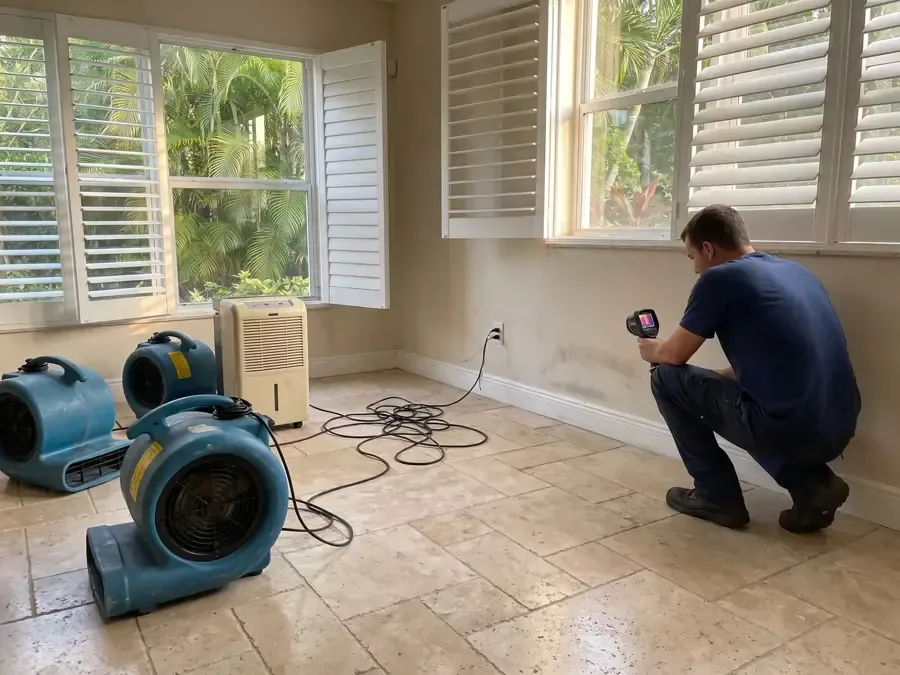
Why the structural drying and dehumidification plan follows the water
Rapid local response
The response team dispatches 24/7 for active water and starts with source control, safety and a full moisture boundary.
IICRC S500 drying standard
The drying team sets category and class, chooses equipment for the evaporation load and verifies progress with daily readings.
Claim-ready documentation
The record can include the source, room diagram, moisture map, category, class, daily logs and photos before removal.
River Parish water knowledge
The crew plans for tropical rain, storm surge, humid air, supply failures and occasional freezing conditions.
How structural drying and dehumidification is handled in Destrehan
Set material references
Affected drywall, wood, concrete, and other assemblies are paired with suitable dry comparison points.
Build the drying environment
Air movement, dehumidification, containment, and access are arranged around the actual moisture map.
Measure and diagnose change
Room conditions and material values reveal progress, stalled sections, renewed water, or blocked evaporation.
Close at stable targets
Equipment is reduced and removed only after the documented materials meet their selected completion goals.
First steps for structural drying and dehumidification in Destrehan
Keep the source controlled
A repaired source is essential. Report renewed dripping, plumbing use, or weather entry because new water changes the moisture map and drying plan.
Leave equipment settings alone
Do not switch off, move, or cover air movers and dehumidifiers unless safety requires it. Placement supports specific measured materials.
Keep doors as instructed
Open or closed doors can change the controlled environment. Follow the technician's arrangement so humid air does not bypass the drying system.
Report access changes
Tell the crew if contents were moved or a room was opened for other work. Changed airflow and barriers can affect the next readings.
Structural drying is the measured work that follows water removal. It does not begin and end with placing fans. The technician identifies which materials retained water, establishes comparison points in unaffected construction, and creates an environment where those materials can release moisture. Each visit tests whether the plan is producing a useful change.
What does structural drying and dehumidification cost in Destrehan, LA?
Structural drying projects commonly range from $1,600 to $8,200 or more. Wet material volume, permeability, access, containment, power, equipment capacity, humidity control, and monitoring needs determine the scope.
Focused loss
$1,600 to $3,724
- Small measured area
- Open material surfaces
- Focused air and dehumidification
Multi-room loss
$3,724 to $5,740
- Several material groups
- Multiple controlled zones
- Repeated equipment adjustment
Complex loss
$5,740 to $8,200+
- Dense or concealed materials
- Special access required
- Broader monitoring record
Ranges are typical, not a quote: category of water, square footage, material class and how fast drying started move the number most. Run the water damage cost calculator for a closer range.
Turning a moisture map into separate drying targets
Drywall, framing, concrete, subfloor, cabinets, and insulation have different structures and different ways of holding water. A single room reading cannot represent them all. Technicians mark locations in each affected assembly and pair them with dry references of the same or similar material. The map also identifies barriers such as vinyl, paint, casework, and insulation.
Destrehan local context includes tropical weather, occasional freezes, and severe rain. In July 2020, intense rainfall was reported in Ormond Estates and along Murray Hill Drive. Those facts support preparedness but do not set a dry goal. The goal for a present building comes from its materials, comparable dry areas, and recorded response.
- Separate surface moisture from concealed assembly moisture
- Choose repeatable points for each material type
- Mark dry references outside the affected boundary
- Identify finishes that restrict vapor movement
- Record the initial room air conditions
Balancing evaporation with dehumidification
Air movers help water leave a wet surface by replacing damp air at that surface. Dehumidifiers capture vapor released into the controlled room. Too little air movement can leave a stagnant layer, while uncontrolled air from outdoors can add humidity. Equipment selection considers the amount and type of wet material, the room volume, and containment.
Placement is a technical choice rather than a visual pattern. A long wall, cabinet base, open subfloor, and concrete section may each need a different approach. Cords and equipment are arranged for safe occupied access. Water extraction remains important because efficient liquid removal reduces the vapor load before structural drying begins.
- Direct air across accessible wet faces
- Use dehumidification to process released vapor
- Control openings that admit humid replacement air
- Protect pathways from cords and equipment discharge
- Match equipment changes to measured material response
Investigating a reading that stops improving
A stalled material is useful information. The crew checks whether airflow reaches it, whether a coating or finish blocks evaporation, whether insulation remains behind it, and whether the source is truly controlled. A small access opening may solve the problem. Adding equipment without diagnosing the barrier can waste time and leave hidden moisture in place.
Psychrometric observations show how the room air is behaving, while material meters show whether construction is drying. Both measurements inform equipment adjustments. A closed cavity may need better access even while room humidity falls. The local restoration hub connects measured drying with the source specific services that prepare materials for this stage.
- Compare current readings with the prior visit
- Check source control when values rise unexpectedly
- Inspect coatings, insulation, and closed cavities
- Move air or create access based on the diagnosed barrier
- Reduce equipment only when the remaining load supports it
Completing the dry record
Final measurements should correspond to the same locations and material types used during monitoring. Photographs show equipment arrangements and any openings created. Logs explain changes to airflow, dehumidification, containment, or material access. Together they establish why the project continued and why it concluded.
Coverage spans Destrehan near Great River Road, Airline Highway, Destrehan Plantation, and the Mississippi River. Location does not replace a material reference. The insurer applies the policy to the cause of loss, while the drying documentation records the technical condition of the building and the work performed.
Equipment reduction is also measured. When the moisture load falls, the drying team can remove or reposition units while watching whether the remaining system maintains progress. A deliberate reduction avoids both unnecessary operation and a premature end to the controlled environment.
A final walkthrough confirms that access openings, containment edges, and equipment paths match the recorded completion condition. Remaining repair needs are identified separately from finished moisture control work.
Structural drying and dehumidification across Destrehan and nearby communities
Structural drying is available throughout the community around Great River Road, Airline Highway, local Plantation, Ormond Estates, and Murray Hill Drive. Material measurements define the working equipment boundary.
The same service nearby: structural drying and dehumidification in LaPlace, Norco, Luling.
Related water damage services in Destrehan
Structural Drying and Dehumidification questions in Destrehan, LA
Wet materials remain after extraction?
Material readings show where airflow or dehumidification needs adjustment and when drying is complete.
(888) 417-5665Request measured structural dryingWhy are fans alone not enough?
Air movement supports evaporation, but released vapor must also be removed from the work area. Dehumidification and environmental control keep damp air from slowing material drying. Both parts must remain balanced.
How are dry goals selected?
Technicians compare affected materials with appropriate unaffected references and consider material behavior. A single universal number does not represent every wood, wall, or concrete assembly.
Why can a reading stop changing?
Coatings, closed cavities, insulation, limited airflow, dense materials, humid replacement air, or a continuing source can stall progress. The barrier is investigated before the plan changes.
Can equipment be turned off at night?
Interrupting the designed system can slow drying and change the controlled environment. Equipment should remain as arranged unless a safety concern requires immediate action.
What is measured besides the room humidity?
Material moisture in drywall, framing, subfloor, cabinets, concrete, and other targets is tracked. Air observations explain the environment but do not replace direct material readings.
When is structural drying complete?
Completion occurs when selected affected materials reach stable documented goals and the moisture boundary is resolved. Surface appearance or a comfortable room is not enough.
What affects the drying price?
Material volume, density, coatings, cavity access, containment, outdoor humidity, electrical capacity, equipment type, floor area, and monitoring work shape the final project scope.
Use material response to direct every equipment change
The drying team establishes references, manages airflow and humidity, investigates stalled assemblies, and records stable completion targets. Final checks return to the original targets.